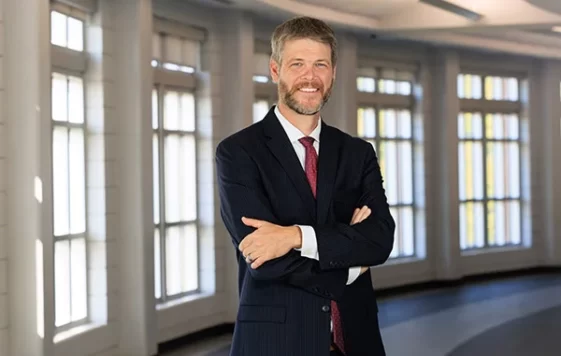
Staff Spotlight: Scott Davis
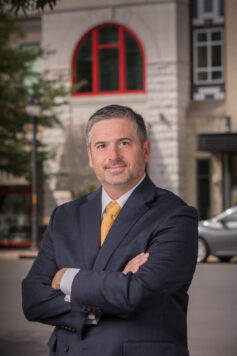
Scott Davis spent much of his early life believing two things with complete certainty: that he would attend a U.S. military academy and that his life’s work would be about service. When a vision-related medical hurdle closed the door on that first dream at the last possible moment, it forced a reckoning– and ultimately set him on a different, but deeply aligned, path.
“I had to pivot,” Davis said. “So I found another way to serve the world– by working at the intersection of innovation, economics, and impact.”
Today, as NCInnovation’s Wilmington Hub Director, Davis draws on a rare combination of entrepreneurial experience, venture capital perspective, and deep local roots to help translate university research into real-world solutions– particularly those rooted in coastal, environmental, and marine sciences.
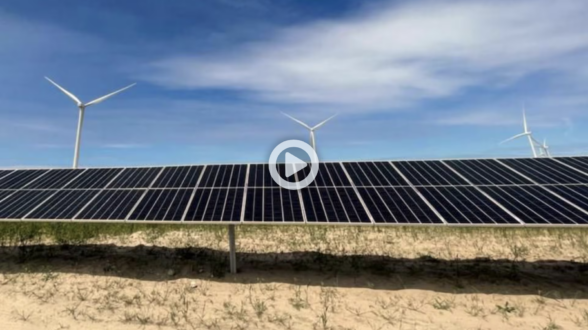
Davis’s journey began at UNC Wilmington, where he studied environmental and natural resource economics under the mentorship of Dr. Peter Schuhmann. As an undergraduate, he founded his first company, Natural Bridges, to help bridge the gap between scientific innovation and viable business models. The startup worked with early-stage technologies ranging from mobile solar power generation to water purification and plastic-to-fuel conversion.
“That experience taught me early how hard it is to move technology from the lab to the market,” he said. “It also showed me how powerful innovation can be when the economics work.”
After his startup years, Davis joined UNCW’s Office of Technology Transfer, where he refined commercialization processes, cultivated the technology pipeline, and helped drive licensing revenue to support future innovation. That role became a springboard into venture capital, where he later worked with two funds in the D.C. metro area investing exclusively in veteran-led startups.
Working at the pre-seed and seed stages, Davis managed national investment pipelines, ran a highly regarded accelerator, and embedded himself inside portfolio companies– building a deep understanding of capital, scale, and what it takes to turn an idea into a sustainable business.
Yet, despite opportunities across the East Coast and beyond, Davis felt pulled back to Wilmington.
“I wanted to take everything I had learned– from North Carolina to D.C. and the West Coast—and apply it directly to the place I’m lucky enough to call home,” he said. “When the Wilmington Hub Director role was created, the timing couldn’t have been better.”
At the heart of Davis’s work is UNC Wilmington, a university he describes as having an unmistakable energy. “UNCW has a certain aura,” he said. “There’s momentum here. It really feels like a rising tide lifting the entire region.”
While known nationally for its strengths in marine sciences, UNCW’s impact extends well beyond the coastline. Davis works closely with faculty translating research with dual-use potential, environmental applications, and relevance to government and industry partners. His background in venture capital and defense-adjacent innovation has proven particularly valuable as faculty explore applied research pathways.
Beyond UNCW, Davis collaborates across the UNC System, including projects with NC State University related to the Blue Economy and work at CMAST in Morehead City, alongside partners such as Carteret Community College and Sturgeon City Environmental Center.
“These collaborations reflect UNCW’s culture,” he said. “Researchers here work across institutions naturally– it’s part of their DNA.”
Regionally, Davis is focused on strengthening industries that define eastern North Carolina’s identity– boat building, fishing, manufacturing, aquaculture, and marine technology– while preparing them for the future.
“We’re asking big questions,” he said. “How do we protect dignified employment in coastal communities? How do we build on decades of marine science research so jobs don’t disappear, but evolve?”
Projects in the pipeline span land-based aquaculture, advanced materials for marine industries, boat-building technologies, and coatings and engineering solutions with both commercial and defense applications. Davis also sees enormous opportunity in aligning university research with community college workforce programs, including Cape Fear and Carteret Community Colleges.
Looking ahead, Davis believes UNCW is on track to become a national model for translational and applied research.
“People want to live here,” he said. “The economy is changing, the talent density is rising, and UNCW is positioned to become a top university in one of the best places to build a business—in America’s most business-friendly state.”
For Davis, the work comes full circle.
“This mission– bridging academia and industry– is exactly why I started my first company,” he said. “At NCInnovation, we’re building companies that create real opportunity. That’s service in the truest sense.”