AI-Powered Microscopy Aims to Save North Carolina Farmers Millions
Intestinal parasites quietly take a heavy toll on livestock across North Carolina and the Southeast. The losses aren’t small — they cut deep into productivity, profitability, and the health of entire herds.
“Intestinal parasites have a large impact on the health and performance of livestock: infections reduce liveweight, feed efficiency and milk yield, and are a leading cause of mortality in young animals,” said Dr. Zach Russell, PhD (ECE), from Appalachian State University’s Department of Physics and Astronomy. “Using cattle as an example, gastrointestinal parasites cost the NC cattle production industry alone an estimated $141 million in 2023, from an inventory of animals worth an estimated $673 million. That is a substantial burden, over 20 percent of the total cattle inventory value.”
For decades, parasite detection has relied on the same painstaking process — examining fecal samples under a microscope and counting parasite eggs by hand.
“The traditional way of identifying parasites is by visually examining fecal samples with a microscope,” Dr. Russell explained. “This method requires a trained technician to manually count and identify parasite eggs by type. This work is tedious, time-consuming, and prone to errors, but also wasteful as that skilled professional could focus on higher-level tasks instead.”
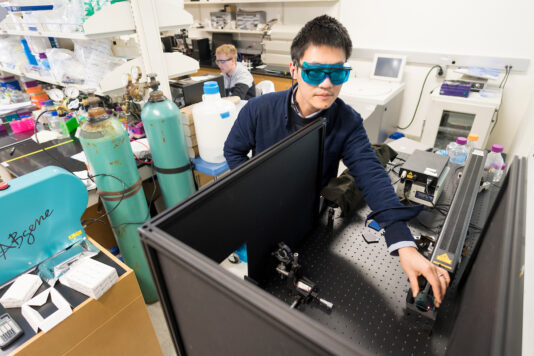
Dr. Russell’s automated microscopy system uses AI to change that equation. “Our system addresses a critical and immediate need for faster, more accurate, and cost-effective fecal analysis,” he said. “The end user of our tool would require far less training to be able to perform the analysis, cutting down the turnaround time from 2–5 days to 10 minutes, with more consistent results than an expert, and at a fraction of the cost. This reduction in turnaround time and cost will enable far more frequent testing, enabling faster, more targeted treatment and fewer animals lost to parasites.”
The technology behind the system has been evolving for about a decade. “We have been developing custom automated microscope and image-processing platforms over the last 10 years for a wide variety of applications,” Dr. Russell said. “Each new application required us to invent solutions to overcome the set of unique technical challenges it presented, such as the ability to rapidly scan and process sample areas thousands of times larger than what a typical microscope sees or increasing contrast on acquired images without relying on dyes or expensive equipment.”
“While we were able to solve these technical problems, all the solutions were targeting niche applications, developed for customers with scientific backgrounds. Applying our technology to a mass-market problem for the public was going to require an extra level of refinement that would not have been financially feasible for us without NCI’s involvement.”
That support began locally. “The Director of our Regional Innovation Network, Meagan Coneybeer, has been an immense support from the very beginning,” Dr. Russell noted. “She not only helped us learn and grow but provided us with her rich portfolio of AgTech connections, from various state and local institutions and clinics, to venture capitalists operating in AgTech, and even education leaders to ensure we have the skilled workforce we need as we grow.”
The next phase is about refinement and real-world validation. “The work we had completed previously has proven that our core technology works in a lab setting,” Dr. Russell said. “Over the next two years, we plan on using the NCI grant funds to adapt the tech specifically to Fecal Egg Counting (FEC) analyses, and to refine the hardware to be ready for testing in the field and validation by accrediting agencies. We are engaging in customer discovery to inform our user experience design, and ensure we build a tool that fits our farmers’ needs and workflow.”
Dr. Russell said NCInnovation’s focus on AgTech funding is driven in part by agriculture being North Carolina’s #1 industry. “NCInnovation has identified AgTech as one of the six strategically important technology focus areas for North Carolina. They demonstrate that importance by focusing strategic investments on this economically critical sector to move university-based research in AgTech from the lab toward commercial success.”
The ripple effects are statewide. “The development of our microscope technology will create jobs in manufacturing, software engineering, tech support, and AI research. These positions require specialized skills and command high salaries. This translates into increased taxable income for NC, boosting state revenue and supporting public services,” he said. “The mentorship program we are engaged in with North Carolina School of Science and Math in Morganton as well as the internships we have been offering at App State will ensure that these positions capture the attention of exceptional students and give them a strong incentive to remain in Western NC.”
Dr. Russell added,“The vast majority of NC’s academic R&D budget consistently goes to three Triangle universities, which has yielded a very skewed distribution of innovation infrastructure within the state that further reduces incentives to fund research initiatives in regional NC universities. NCInnovation’s focus on regional universities such as App State will strengthen regional innovation, develop commercialization infrastructures, and attract industry investment.”
“The people best suited to solve a problem are the ones that are closest to it,” he said. “Every region has unique problems. Making sure that regional universities like App State have R&D funding allows them to be the anchor for innovation in Western NC, funding the people closest to the local problems and best able to solve them.”
“The goal of our AI microscope is to help farmers in NC save money by reducing the livestock lost to parasites. We will make it fit into their workflow, so they don’t have to spend their valuable time mailing out samples, waiting days or weeks for results, ”Dr. Russell said. “The introduction of faster, more reliable, and less expensive fecal egg counting will enable more proactive herd monitoring rather than reactive testing when a parasite load is suspected. Shifting from reactive to proactive medicine will lead to earlier disease detection. This will allow for more targeted treatments, better contagion containment, yielding improved livestock health, less time spent tending to sick animals, and reduced losses caused by parasites.”
He added that the gains extend to competitiveness: “The increased profitability will allow farmers to compete more effectively with out-of-state producers, potentially bringing about lower prices for consumers. Furthermore, the recent floods in Western NC are going to have long-term negative impacts on livestock production. Increasing these farmers’ return on investment could offset these impacts and allow them to continue being competitive with out-of-state producers.”
Dr. Russell is clear about what made this possible: “Without the support of NCI, this technology would not make the transition from the research labs to the farms where it can truly make an impact.”