An NCInnovation Supported Researcher Brings Dual-Use AI Work to MIT
When Dr. Sambit Bhattacharya arrived at MIT, he wasn’t there to present a finished product or pitch a startup. Instead, the Fayetteville State University professor was taking part in a selective program designed for something much earlier — and often harder — in the innovation lifecycle: translating research into real-world use.
Bhattacharya was accepted into Dual Use Ventures (DUV26), a program hosted at the MIT Sloan School of Management by MIT Mission Innovation X. The program brings together researchers, founders, government practitioners, investors, and defense experts to explore how emerging technologies can serve both commercial markets and mission-critical government needs.
For Bhattacharya, the opportunity aligned naturally with the direction of his work and with the early momentum of a recently awarded NCInnovation project.
At its core, dual-use innovation refers to technologies that can serve more than one purpose, often both civilian and government or defense applications. But Bhattacharya is quick to explain that it’s not just a label. It’s a strategy.
“When you’re building technology for the Department of Defense, it’s a good idea to also explore commercialization potential for the same technology,” he said. “Defense funding can change, and a steady stream of revenue is difficult. Commercialization gives you another path forward.”
In Bhattacharya’s case, that path runs through artificial intelligence.
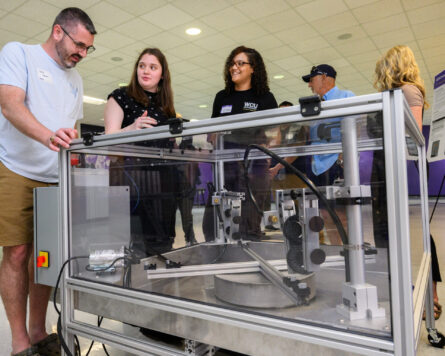
His NCInnovation-supported research focuses on AI models capable of predicting how objects respond to kinetic impact– essentially forecasting what will happen when forces collide. That capability has clear relevance in defense environments, such as battlefield scenarios, but it also extends into civilian applications like radiation-based medical treatments, where understanding how tissue responds to energy is critical.
Dual Use Ventures participants are selected through a competitive process, and the cohort is intentionally small and interdisciplinary. While Bhattacharya believes the dual-use framing of his NCInnovation-funded work played an important role. “I did provide information about the NCInnovation project and the dual-use case,” he said. “That is likely what attracted their attention.”
Equally important was context. Bhattacharya emphasized the role of Fayetteville State University’s proximity to Fort Bragg and the lab’s engagement with defense-adjacent stakeholders, including leaders connected to the Joint Innovation Outpost (JIOP). Those relationships — many of them already in place — helped demonstrate that the research was not happening in isolation.
“They recognize the importance of that ecosystem,” he said.
Bhattacharya is careful not to overstate the immediate impact of any single program or experience. His NCInnovation project is still in its early stages, and he readily acknowledges that uncertainty is part of the process.
But the MIT experience, he said, reinforced the value of being positioned early to explore commercialization pathways.
At DUV26, participants discussed the changing federal funding landscape, including growing uncertainty around traditional programs like SBIR and STTR. Sessions highlighted alternative mechanisms such as Other Transaction Authorities (OTAs) and Commercial Solutions Openings (CSOs), which Bhattacharya said were especially useful to learn about.
“These are practical things,” he said. “It helps you think differently about how technologies move forward.”
The program also brought exposure to founders who had navigated early success with the Department of Defense — a rare and often difficult feat — as well as venture capitalists and international partners. Bhattacharya left MIT with new professional connections, follow-up meetings scheduled with MIT Mission Innovation X staff, and a clearer sense of how his work might evolve beyond the lab.
For NCInnovation, Bhattacharya’s experience illustrates a broader point: early-stage support doesn’t just fund research. “It opens doors,” Bhattacharya said. “It allows you to be part of discussions you might not otherwise be invited into.”